Why Every Website Needs an Audience
Your website is your brand’s digital home. But without a steady flow of targeted visitors, it can’t generate leads, sales, or awareness. Attracting the right audience ensures that your website does what it’s meant to do — inform, engage, and convert. The key is not just traffic, but qualified traffic — people who are actually interested in your product or service.
Understanding the Growth Pillars: SEO, AIO, AEO, and GEO
To build consistent audience growth, you need multiple forms of optimization working together — each one targeting a unique aspect of how users discover and interact with your website.
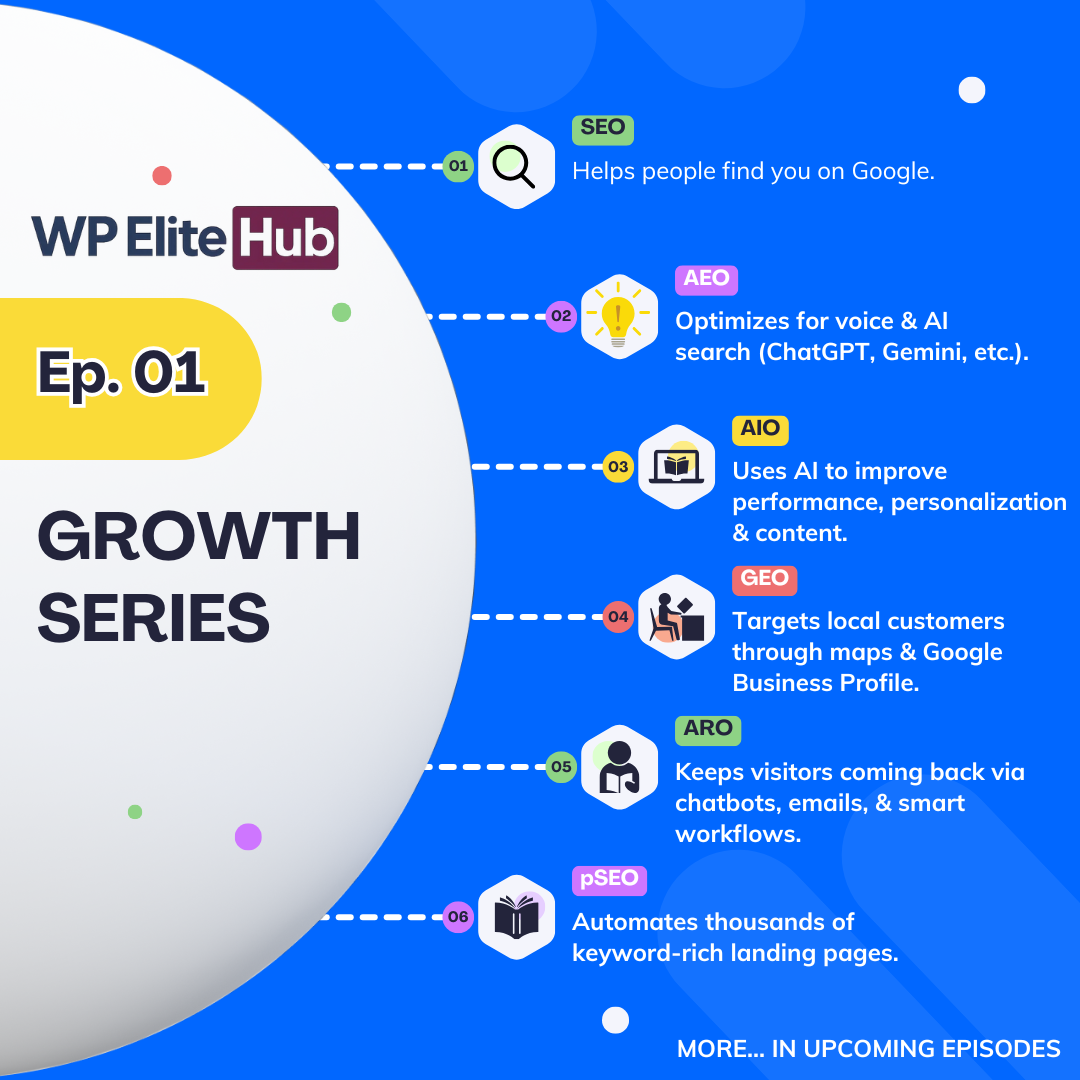
1. SEO (Search Engine Optimization)
SEO is the foundation of organic traffic. It helps your website rank higher on Google and other search engines. With strong SEO, your business becomes visible when users search for topics, products, or services you offer.
- On-Page SEO: Optimizing titles, headings, keywords, and content.
- Technical SEO: Improving speed, mobile performance, and site structure.
- Off-Page SEO: Building authority through backlinks and mentions.
- Content SEO: Creating value-rich blogs, guides, and pages that solve problems.
Goal: Help people find you when they search for solutions you provide.
2. AIO (AI Optimization)
AIO, or AI Optimization, is about integrating Artificial Intelligence tools and systems into your digital presence to make your website smarter. AI can analyze user behavior, personalize experiences, and optimize performance automatically.
- AI-driven keyword & content analysis.
- Personalized user journeys and recommendations.
- Automated content improvement suggestions.
- Predictive analytics for marketing strategy.
Goal: Make your website intelligent, adaptive, and self-improving.
3. AEO (Answer Engine Optimization)
Search is evolving. People no longer just “search” — they “ask.”
Answer Engine Optimization helps your website appear in voice searches, AI chat results, and featured snippets.
- Optimize for conversational queries (“How to…”, “What is…”, “Why does…”).
- Add FAQ sections with structured schema markup.
- Use natural language and clear formatting for direct answers.
- Target featured snippets and voice responses from AI assistants.
Goal: Position your site as the go-to source for quick, accurate answers — perfect for AI search models like ChatGPT or Gemini.
4. GEO (Geographical / Local Optimization)
For local businesses, GEO optimization ensures your website is visible in geographically relevant searches. Whether you’re a café, service provider, or regional brand, location-based visibility is essential.
- Set up & optimize Google Business Profile.
- Use local keywords and city-based landing pages.
- Encourage and respond to reviews.
- Maintain NAP consistency (Name, Address, Phone).
Goal: Bring nearby customers directly to your business — online and offline.
5. pSEO (Programmatic SEO)
Programmatic SEO helps you generate thousands of optimized pages automatically using templates and databases. Perfect for SaaS, directories, eCommerce, and large content websites.
- Create scalable landing pages for long-tail keywords.
- Use structured data for better indexing.
- Automate page creation while maintaining quality control.
Goal: Capture untapped long-tail search opportunities efficiently.
6. VEO (Voice Engine Optimization)
With more users searching by voice, VEO focuses on making your website voice-friendly. This includes natural-speech keywords, question-based content, and quick-loading mobile designs.
- Optimize for voice-friendly phrases.
- Use conversational tone in content.
- Ensure mobile-first design and quick load times.
Goal: Capture voice searches made on mobile and smart devices.
7. EEO (Experience Engine Optimization)
EEO focuses on user satisfaction — combining UX design, engagement analytics, and retention strategies. It ensures visitors don’t just come — they stay, explore, and convert.
- Interactive layouts and micro-animations.
- Personalized recommendations and CTAs.
- Session tracking to identify drop-off points.
Goal: Improve user engagement and build long-term loyalty.
8. SSO (Social Search Optimization)
Social platforms are search engines too. SSO ensures your brand appears when users search on LinkedIn, YouTube, Instagram, or X.
- Optimize social profiles and hashtags.
- Post keyword-rich social content.
- Cross-link your website and social assets for visibility.
Goal: Expand brand reach beyond Google — meet your audience where they scroll.
9. MEO (Mobile Engine Optimization)
Over 60% of web traffic now comes from mobile. MEO ensures your site loads fast, looks great, and converts smoothly on mobile devices.
- Responsive design across all screen sizes.
- Mobile-first indexing compliance.
- Touch-friendly buttons and menus.
Goal: Provide a seamless mobile experience that drives conversions.
10. ARO (Automation & Retention Optimization)
ARO combines automation with customer retention — making your site smarter and more proactive in keeping visitors engaged.
- Email sequences for abandoned leads.
- Chatbots for instant engagement.
- CRM integrations for nurturing and re-targeting.
Goal: Turn first-time visitors into long-term clients automatically.
The Power of Multi-Dimensional Optimization
When these systems work together — SEO + AIO + AEO + GEO + others — your website becomes a true growth ecosystem. Each element attracts, engages, and retains the right audience, creating sustainable long-term results.
Conclusion: Build an Audience, Not Just a Website
In the modern web, design alone doesn’t build growth — visibility does. To create a website that actually performs, you need traffic, trust, and automation. Combining SEO, AI optimization, local reach, and answer-focused strategy ensures your website evolves into an active business tool — one that continuously brings in the right audience and converts them into clients.
Your website doesn’t just need visitors — it needs the *right audience.* And these optimization methods are how you find them.