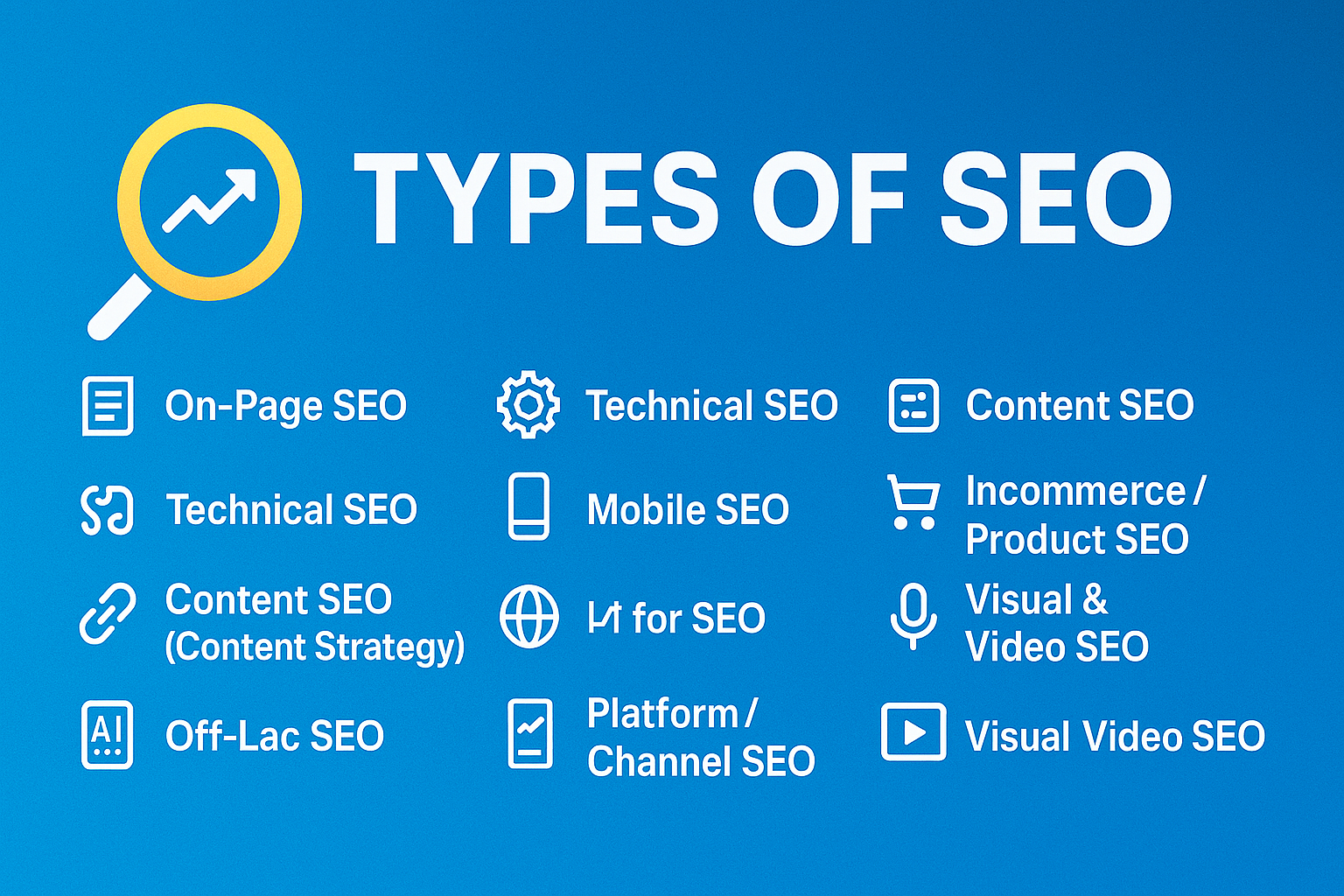
Why SEO Matters in Digital Marketing
Today, more than 90% of online experiences begin with a search engine. If your business is not visible when people are searching for solutions you offer, you’re invisible to potential customers. SEO ensures that your website ranks higher on search results, builds trust with your audience, and delivers long-term traffic growth without relying solely on ads.
1. On-Page SEO
On-Page SEO focuses on optimizing the visible elements of a webpage. It ensures that your content, titles, URLs, and internal links are aligned with user intent. By structuring your pages properly, you make it easier for both users and search engines to understand your content.
2. Technical SEO
Technical SEO is about improving the infrastructure of your website. This includes crawlability, indexing, loading speed, HTTPS security, mobile optimization, XML sitemaps, and schema markup. Without a strong technical foundation, even the best content may fail to rank.
3. Content SEO (Content Strategy)
Content SEO emphasizes creating high-quality, valuable, and intent-driven content. Strategies include building topic clusters, updating older posts, and ensuring content freshness. The goal is to provide useful answers to what people are searching for, boosting authority and relevance.
4. Off-Page SEO (Link Building & Reputation)
Off-Page SEO refers to activities outside your website that improve rankings. This mainly includes backlinks from trusted sites, PR mentions, social signals, and influencer collaborations. These external endorsements signal to Google that your site is authoritative.
5. Local / GEO SEO
Local SEO optimizes your business for geographically-relevant searches. By claiming and optimizing your Google Business Profile, adding local keywords, and ensuring NAP (Name, Address, Phone) consistency, you make your business visible to nearby customers.
6. Programmatic SEO (pSEO)
Programmatic SEO is about generating thousands of keyword-optimized pages at scale using templates. It is widely used by SaaS platforms, directories, and marketplaces. When done right, pSEO helps capture long-tail keywords that bring consistent organic traffic.
7. AI for SEO
Artificial Intelligence (AI) is transforming SEO workflows. AI tools assist in keyword clustering, content briefs, SERP analysis, and automated optimization. However, AI-driven SEO still requires human oversight to ensure quality and accuracy.
8. Mobile SEO
With mobile-first indexing, Google prioritizes mobile versions of websites. Mobile SEO ensures your site is responsive, loads quickly on phones, and provides an excellent user experience. Since more than 60% of searches happen on mobile, this is non-negotiable.
9. E-commerce / Product SEO
Product and category pages require their own SEO strategies. E-commerce SEO focuses on product schema, faceted navigation, unique product descriptions, reviews, and optimized images. This helps you capture traffic from purchase-ready customers.
10. International / Multilingual SEO
For businesses targeting global markets, International SEO ensures the right content shows up for the right audience. This involves hreflang tags, localized content, country-specific domains, and translation strategies.
11. Voice & Conversational SEO
With the rise of smart speakers and voice assistants, Voice SEO targets natural, conversational queries. Optimizing for featured snippets, FAQs, and question-based content improves your chances of appearing in voice search results.
12. Visual & Video SEO
Visual SEO focuses on optimizing images, while Video SEO enhances your chances of ranking on YouTube and Google Video results. Adding transcripts, alt tags, schema markup, and thumbnails makes your visual content more searchable.
13. App Store Optimization (ASO)
For apps, ASO improves discoverability inside app stores like Google Play and Apple App Store. This involves optimizing app titles, descriptions, screenshots, ratings, and reviews to increase installs and visibility.
14. Platform / Channel SEO
SEO principles apply differently across platforms like YouTube, Amazon, Pinterest, and LinkedIn. Each platform has unique ranking factors, and optimizing for them ensures higher visibility where your audience spends time.
15. Enterprise SEO
Enterprise SEO is designed for large, complex websites with thousands of pages. It involves governance, scalable indexing, cross-team workflows, and careful site migrations to maintain rankings at scale.
16. Behavioral & Conversion SEO
This type focuses on improving behavioral signals like click-through rate (CTR), dwell time, and conversion funnels. It connects SEO directly with business metrics, ensuring your traffic translates into real results.
17. Negative SEO Monitoring & Recovery
Competitors or malicious actors may try to harm your rankings with spammy backlinks or content scraping. Negative SEO monitoring ensures you detect and recover from such attacks before they damage your visibility.
18. Podcast & Audio SEO
Podcast SEO makes your audio content discoverable on search engines. Adding transcripts, detailed show notes, and schema for episodes allows podcasts to appear in Google search results, increasing reach.
Conclusion: Building a Complete SEO Strategy
SEO is not a one-time checklist—it’s an ongoing, multi-disciplinary strategy. By combining different types of SEO such as On-Page, Technical, Content, Local, Programmatic, and AI-driven SEO, businesses can build a strong online presence. Each type complements the other, turning your website into a long-term growth engine that attracts, engages, and converts your ideal customers.